

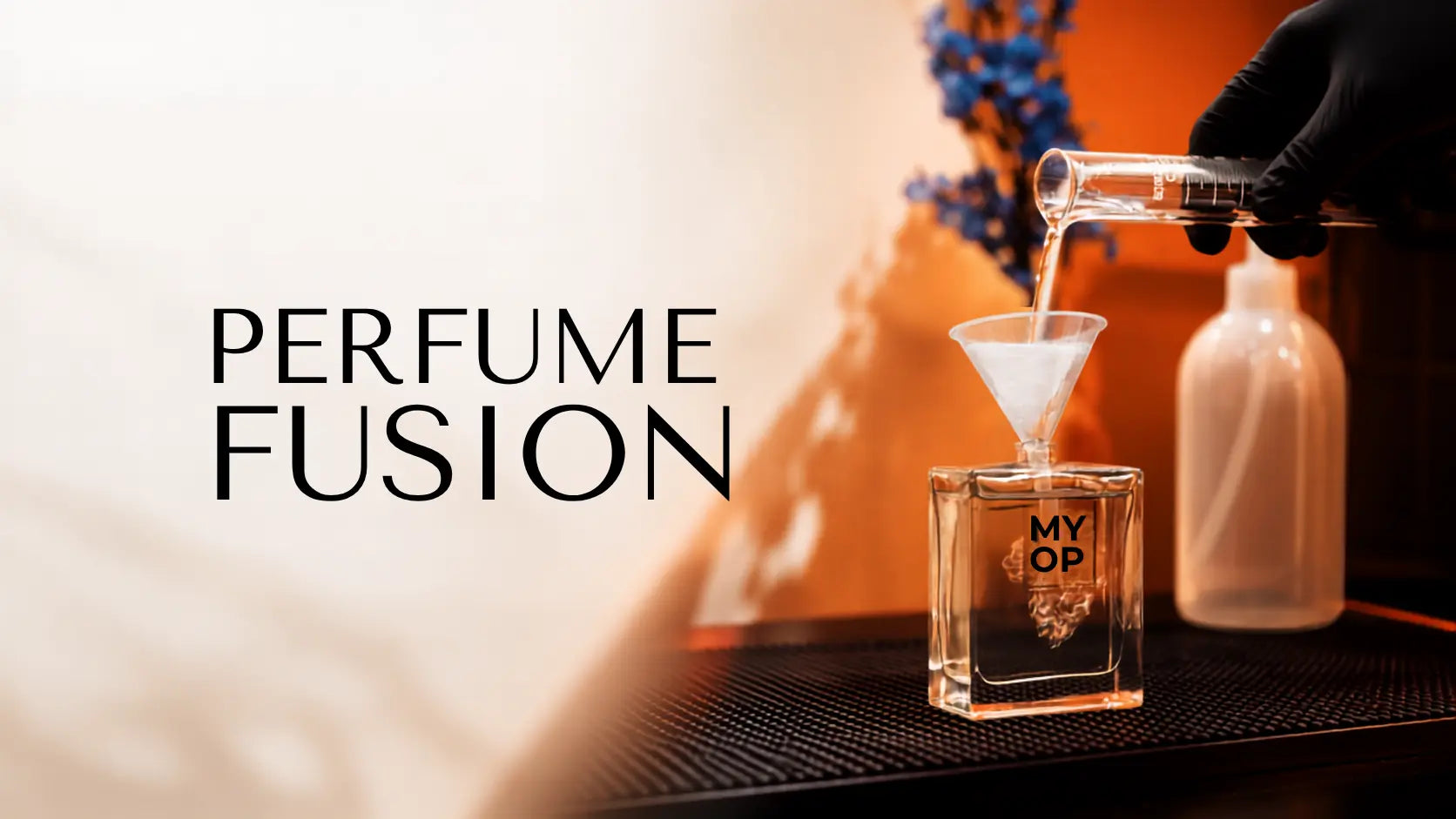
Blending two perfumes into one bottle isn't the same as wearing both at once. Perfume fusion combines two finished fragrances into a single liquid before it touches your skin, which means the two formulas compete inside the bottle instead of on your wrist. That changes what you smell, how long it lasts, and which notes survive the first hour. Get the ratio right and you end up with a scent nobody else owns. Get it wrong and you've flattened two perfumes you already liked.
What Is Perfume Fusion?
Perfume fusion is the practice of blending two finished perfumes into a single bottle, in a ratio you choose, so they wear as one scent.
At MYOP, that's a named thing. Fusion happens at the counter, in front of you. You pick two perfumes off the wall, decide how much of each goes in, and the staff blend it into one bottle while you wait. It takes about ten minutes. You can go beyond two, though most people don't.
The home version of this is an experiment. Somebody pours half of one bottle into a decant of another and hopes. The result is usually muddy, because two perfumes built at different oil concentrations don't combine the way the ratio suggests they will.
The in-store version isn't a gamble, for one reason: every MYOP perfume is built on the same 50% compound formulation. Equal footing. When you ask for 70/30, you get 70/30.

Fusion vs Layering: What Actually Changes
Perfume layering keeps two scents separate and lets them meet on your skin. Fusion combines them in the bottle first, so what reaches your skin is already one scent.
That difference decides everything else. With layering, order matters: the heavier perfume goes down first so the lighter one isn't smothered. With fusion, order is meaningless. The two liquids are already one liquid. Ratio is the only lever you have, and it's a strong one.
Layering is also reversible. Wash your wrists and you're back to two separate perfumes on the shelf. A fusion is a decision. You've made a third perfume, and the bottle in your hand is now its own thing.
Layered scents also dry down at different rates on different spots, so you get two timelines running at once. A fusion gives you one.

The Science: Why Two Perfumes Don't Simply Add Up
Two perfumes don't add up because their ingredients evaporate at different speeds, so a blend rearranges itself the moment it hits skin.
That's what fragrance notes actually describe. Top, middle and base aren't stages you pass through in order. They're groups of molecules sorted by volatility, meaning how fast each one leaves. The perfumer W.A. Poucher ranked fragrance materials on an evaporation scale of 1 to 100, light at one end, heavy at the other. Small molecules go first. Heavy ones stay.
Blend two perfumes and you're stacking two timelines. Every top note from both bottles leaves inside roughly the same window. What's left is a mix of two base structures, and that mix is what people smell on you for most of the day.
Take The Woody, built on incense, saffron and cedarwood. Blend it with The Legend, which opens on bergamot. The bergamot leads. By hour three, you're wearing cedarwood and ambergris with a memory of citrus.
Heat speeds all of this up. Step out of a Chennai mall at 4pm in May and the top-note window shrinks to almost nothing, which is exactly why the base you blend matters more here than it does in London.

Why Fragrance Oil Concentration Decides Your Blend
Oil concentration decides how much of each perfume you actually smell, not the amount you poured in.
Here's why that matters. If you blend a 20% eau de parfum with a 10% eau de toilette at equal volume, you haven't made a 50/50 scent. You've made something closer to 67/33, and diluted both with the alcohol that came along. Home blends fail here more often than they fail on taste.
MYOP perfumes are all built at the same 50% compound formulation, reformulated for tropical weather. Two bottles off the same wall carry the same oil load. So the ratio you ask for is the ratio your nose gets, and the blend doesn't quietly lose strength on the way into the bottle.
A 50/50 fusion is the obvious instinct and usually the least interesting result. Two equal halves tend to cancel each other's character and leave you with something pleasant and vague. Give one perfume 70% and let the other do a job: add sweetness, add smoke, cut the sharpness. Lopsided blends have a shape. Even ones often don't.

How to Blend Two Perfumes Without Ruining Both
Pick one perfume to lead, one to support, and keep the ratio lopsided.
Contrast works better than similarity. Two florals give you a blurrier floral, not a richer one. A woody base under a citrus opening gives you something neither bottle could do alone. Calicut Spice runs on cardamom, cinnamon and tonka. It does more for a fresh scent than another warm one ever will.
Smell it on skin before you commit. Paper strips don't have body heat, and body heat drives the whole evaporation sequence. Thirty seconds on a blotter tells you almost nothing about hour four.
Then give it time. A fresh blend isn't finished the second it's poured. The materials need a few days to settle. The version you smell on day five is usually rounder than the one you smelled at the counter.
Doing this at home? Work in a 2ml vial, not a 50ml bottle. It also helps to understand how perfume is actually built before you start pouring. The people who regret blending are almost always the ones who committed a full bottle to a guess.
Frequently Asked Questions
Can you mix two perfumes in the same bottle?
Yes. The results depend on whether the two perfumes have similar oil concentrations, because mismatched strengths mean the stronger one takes over no matter how much of each you poured. Start in a small vial.
Is perfume fusion the same as perfume layering?
No. Layering keeps two perfumes separate on your skin and depends on the order you apply them. Fusion blends them into one liquid first, so ratio replaces order as the thing that matters.
How long does a MYOP Fusion take?
About ten minutes at the counter. You pick the two perfumes and the ratio, and the blending happens in front of you.
Does blending two perfumes make the scent last longer?
Not on its own. Longevity comes from oil concentration and from how heavy the base notes are. Blend two light citrus perfumes and the result fades as fast as either one did.
Which perfumes shouldn't you blend together?
Two from the same family, and two very sweet ones. Same-family blends come out muddier rather than richer, and stacked sweetness gets heavy fast in warm weather.
Your Turn at the Counter
Blending is one of the few things in fragrance you can't judge from a screen. You need two open bottles, your own skin, and about ten minutes at the counter. The staff will talk you out of at least one bad idea. Walk into any MYOP store across India and ask for a Fusion.
Share:
Personalized Perfume Gifts: Why They Mean More in 2026
Why the Same Perfume Smells Different on You vs Your Friend