

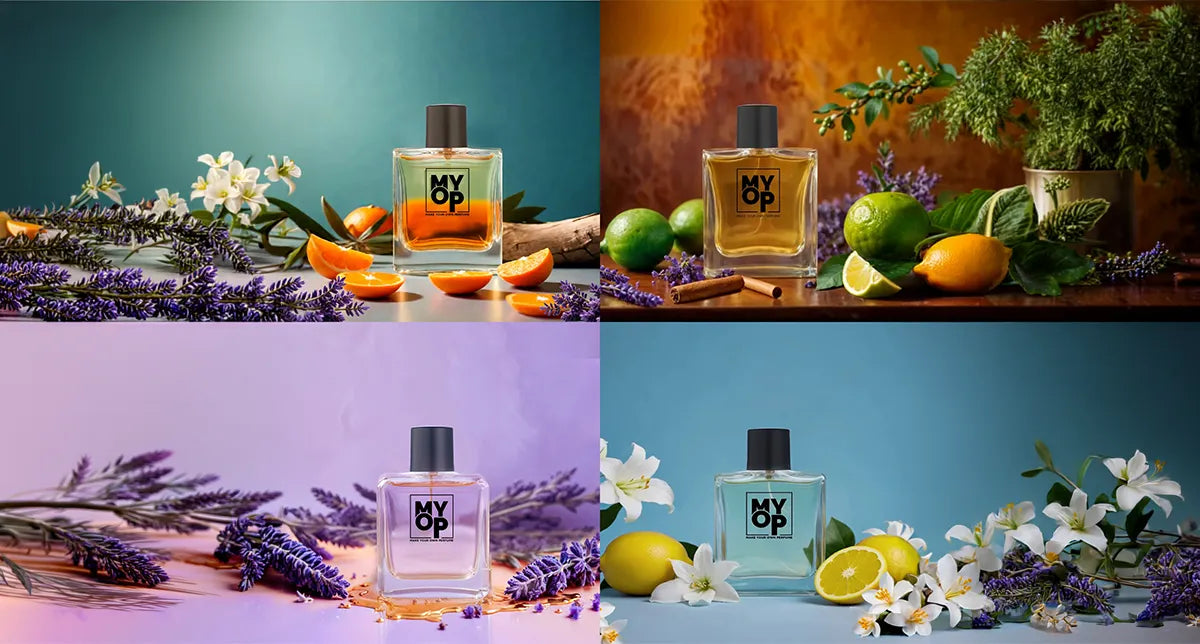
You spray your perfume before leaving for work in Mumbai, and by the time you're off the train, it's already gone. That's fragrance oil concentration at work: the percentage of pure perfume oil mixed into alcohol and water, and it decides almost everything about how long a scent survives your day. Most Eau de Toilette sits at just 5 to 15% oil. MYOP's 50% compound formulation is roughly double a standard Eau de Parfum. That gap is the difference between reapplying at lunch and not thinking about it again until dinner.
What is fragrance oil concentration, exactly?
Fragrance oil concentration is the percentage of aromatic compound in a bottle. Everything else is a carrier, usually alcohol, sometimes water too.
Perfumers call the aromatic part the compound: the actual blended oils that carry every note you smell, the top notes that hit first and the base notes that stay on your skin for hours. A higher number means more compound and less carrier. That's it. It's not a grading system or a quality score.
It's a ratio, and that ratio decides two things: how strong a scent hits in the first hour, and how long it lasts after that. In India, that percentage is rarely printed on the box, so most shoppers are comparing bottles blind: brand name and price standing in for the one number that actually predicts performance. It should be on every label.

EDT vs EDP vs Parfum: what's the real difference?
EDT, EDP and Parfum are concentration tiers, and the jump between them is bigger than most people expect. Eau de Toilette (EDT) sits at 5 to 15% aromatic compound and typically lasts 4 to 6 hours on skin. Eau de Parfum (EDP) moves up to 15 to 20%, closer to 6 to 8 hours. Parfum, sometimes labelled Extrait de Parfum, goes as high as 20 to 40%, and a good one can last 12 hours or more without a single reapplication. The Fragrance Society, which tracks these ranges closely, puts that same 40% figure as the ceiling.
There's a lighter tier below EDT too. Eau de Cologne and Eau Fraîche both sit under 5%, built for a quick, light hit that fades in an hour or two. Body mists and fragrance sprays usually live here as well.
MYOP skips the tiering system and formulates every perfume with a 50% compound formulation, past even most Parfum. It's not a fourth category on the chart. It's a decision to build for one climate instead of the European weather the EDT and EDP system was designed around.
Is a higher concentration always better?
No. A higher concentration is not automatically better, it's just a different tool for a different day. A light 8% EDT is the right call for a gym bag or a quick errand, when you want a trace of scent, not a signature. A 20% EDP or higher makes more sense for a full workday, a flight, or anything longer than four hours.
Here's the part most people get backwards: spraying more of a weak formula doesn't fix it. Four extra sprays of a 6% EDT will make you smell strong for twenty minutes, then nothing, because you've flooded the top notes without adding any of the oil that would have carried a base note into the evening. Concentration isn't a volume problem. It's a formulation one.
That said, in a country where most days sit above 30 degrees, the maths tilts hard in favour of higher concentration, almost every time.
Why does concentration matter more in Indian weather?
Concentration matters more in Indian weather because heat speeds up evaporation, and evaporation is the entire mechanism behind a fragrance fading. The alcohol carrier evaporates first no matter where you are. What's left behind after that is the oil, and the more oil there was to begin with, the longer it keeps releasing scent onto your skin.
Step out of an air-conditioned office into a Delhi afternoon in May and you can feel the shift in seconds. That heat does to a 6% EDT in an hour what it might take a full day to do to a 50% formula. This is also where sillage comes in: the trail a fragrance leaves as it moves through the air around you. Heat lifts sillage fast and burns through it just as fast, unless the formulation has enough compound to keep releasing scent as the hours pass.
This is the actual mechanism behind why MYOP is reformulated for tropical weather. It wasn't built to smell stronger. It was built to still be there at 7pm.
FAQ
What is the difference between EDT and EDP?
EDT (Eau de Toilette) sits at 5 to 15% fragrance compound and lasts 4 to 6 hours. EDP (Eau de Parfum) sits at 15 to 20% and lasts 6 to 8 hours. The higher percentage in EDP means more oil and a slower fade.
Does spraying more perfume make it last longer?
No. Extra sprays add more of the same weak formula, so you smell it strongly for a short burst and then it drops off just as fast. Longevity comes from the concentration itself, not the amount you apply.
Is Parfum always better than EDP or EDT?
Not always. Parfum lasts the longest but tends to sit closer to your skin, while EDT projects further at first and fades sooner. The right pick depends on the occasion, not a ranking.
What percentage is MYOP's perfume?
MYOP uses a 50% compound formulation across its perfumes, reformulated for tropical weather. That's roughly double a standard Eau de Parfum.
Why does my perfume fade faster in summer?
Heat speeds up evaporation, and evaporation is what makes a fragrance fade. A lower-concentration formula has less oil to begin with, so it runs out of scent to release much faster once the heat gets to it. Carrying a top-up, like the Perfume Pod, helps bridge the gap on the hottest days.
What is sillage, and how is it related to concentration?
Sillage is the trail a fragrance leaves in the air as you move. Higher-concentration formulas generally build a stronger, longer sillage, because there's simply more oil to release into the air over time.
Conclusion
None of this means memorizing percentages before you buy a bottle. It means asking a better question: not "how long does it last," but "what's actually in it." A 50% compound formulation isn't a marketing line. It's the reason a MYOP scent is still there after the metro ride home.
Percentages don't lie. Walk into MYOP. Smell what 50% actually feels like.
Share:
Tropical and exotic fragrance picks
Best Perfume Gifts in India: The Complete Guide